
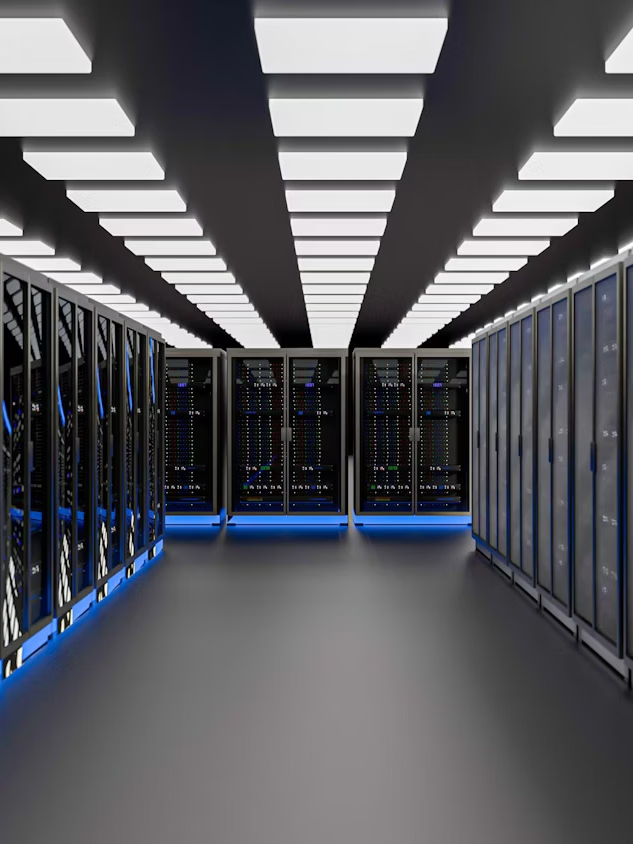
The digital revolution, accelerated by the growth of the Internet, the constant increase in computer and network capacity, and the storage of data in the dematerialised Cloud, has led to the construction of more and more industrial buildings to house ever-greater numbers of computer servers. These servers need a lot of energy to operate, but also to cool down and avoid overheating. Finally, they also need to be in continuous service, 24 hours a day, 7 days a week, and cannot depend on a breakdown in the network.
Our solutions in action
A mobile datacenter powered without emission
At the occasion of Hannover Messe trade show, EODev and Leadership Datacenter partnered to power without emission a mobile edge datacenter thanks to the parallelization of two solutions : the GEH₂ fuel cell generator and BESSTIE energy storage battery.

Data center power supply: why the grid is no longer enough
The rise of hyperscale, artificial intelligence and high-performance computing is driving power requirements sharply upward. A dense compute hall now consumes several times what an equivalent facility drew a decade ago, and per-rack density keeps climbing with AI-dedicated architectures. At the same time, grid operators are quoting interconnection queues of two to five years across most US and European markets. A facility ready to open but without electricity loses its market.
On top of this scheduling constraint sits a regulatory one. ESG frameworks require detailed emissions reporting, taxonomy alignment conditions access to certain financing, and Low Emission Zones extend to the metropolitan areas where data centers are precisely being built. Conventional combustion-based solutions, still dominant, have become a pressure point: CO₂ and NOx emissions, particulate matter, noise, and dependence on fossil fuel supply chains.
A data center power supply must therefore combine three attributes that are difficult to reconcile: availability compatible with 24/7 service commitments, compliance with tightening emissions and noise regulations, and deployment speed aligned with time-to-market pressure. Generating electricity onsite answers all three, without depending on utility timelines.
How to power a data center without depending on grid interconnection

Skipping grid connexion queue
A high-capacity electrical connection is measured in years, between application processing, reinforcement works and commissioning. A gas distribution connection is obtained on timescales that bear no comparison. That gap is what makes operation possible: the site opens, produces and bills while it waits for its definitive electrical capacity — or chooses to do without it altogether.
The same logic applies to expansions as much as to new builds. An existing data center reaching the ceiling of its contracted capacity can add onsite generation rather than wait for a reinforcement, unlocking the commercialisation of additional halls.
Sizing against the real load
Sizing starts from the IT load, to which you add cooling, electrical distribution and technical lighting. These auxiliaries account for a significant share of total consumption: sizing on rack power alone leads to systematic under-provisioning, which becomes costly during ramp-up.
A modular architecture changes the investment logic. Rather than committing the full target output on day one, it lets you add units as halls fill up. An edge facility starts with a single unit; a growing site scales progressively toward several megawatts.


Efficiency and operating cost
On continuous generation, efficiency drives the bill directly. A combustion engine converts roughly 40% of the fuel’s energy into electricity; electrochemical conversion exceeds 60%. Over 24/7 operation, that gap translates into tens of percentage points of avoided consumption, and the heat produced remains available for the building’s thermal needs.
Decarbonisation and regulatory compliance
Beyond availability, the choice of a power source now factors in ESG reporting, taxonomy alignment and Low Emission Zone restrictions. Generation without combustion removes local NOx and particulate emissions, and lifts part of the siting constraints that apply in dense environments: setback distances, flue gas treatment, operating hour limitations.
Vous avez une question, nous avons la réponse.
Onsite generation lets you open and operate a facility without waiting for definitive electrical capacity. A gas distribution connection is obtained on far shorter timescales than a high-capacity electrical upgrade, making operation possible as soon as the building is delivered. The installation can then be kept alongside the grid supply, or maintained as the primary source.
Sizing starts from the IT load, plus cooling, electrical distribution and technical lighting. A single GE-HT unit delivers 600 kW; combining units covers multi-megawatt requirements, with capacity added progressively as halls fill up.
Generation without combustion emits no NOx or particulates in operation, making it compatible with Low Emission Zones and consistent with an ESG reporting trajectory. Progressive hydrogen blending strengthens that trajectory without changing equipment.
Yes. Combining modular units with solar PV and battery energy storage forms a self-sustaining microgrid or a grid-tied architecture, with automatic load balancing and full island mode capability.
A conventional generator answers an occasional need and works by combustion, while the SOFC Onsite Power generation system is using a solid oxyde fuel cell that generates near zero emissions.


