
The market for electric vehicles is growing exponentially, driven by a desire for sustainable transport, government subsidies, tax breaks and a wider range of products from car manufacturers. However, the network of public charging facilities for electric vehicles is still inadequate, and in many places the network is not powerful enough to accommodate them. Hence the interest in using a battery energy storage system such as BESSTIE combined with a hydrogen generator such as GEH₂.
Our solutions in action
Electric vehicle recharging
Lexus uses GEH₂ to recharge its fleet at the launch of its new range near Aix-en-Provence

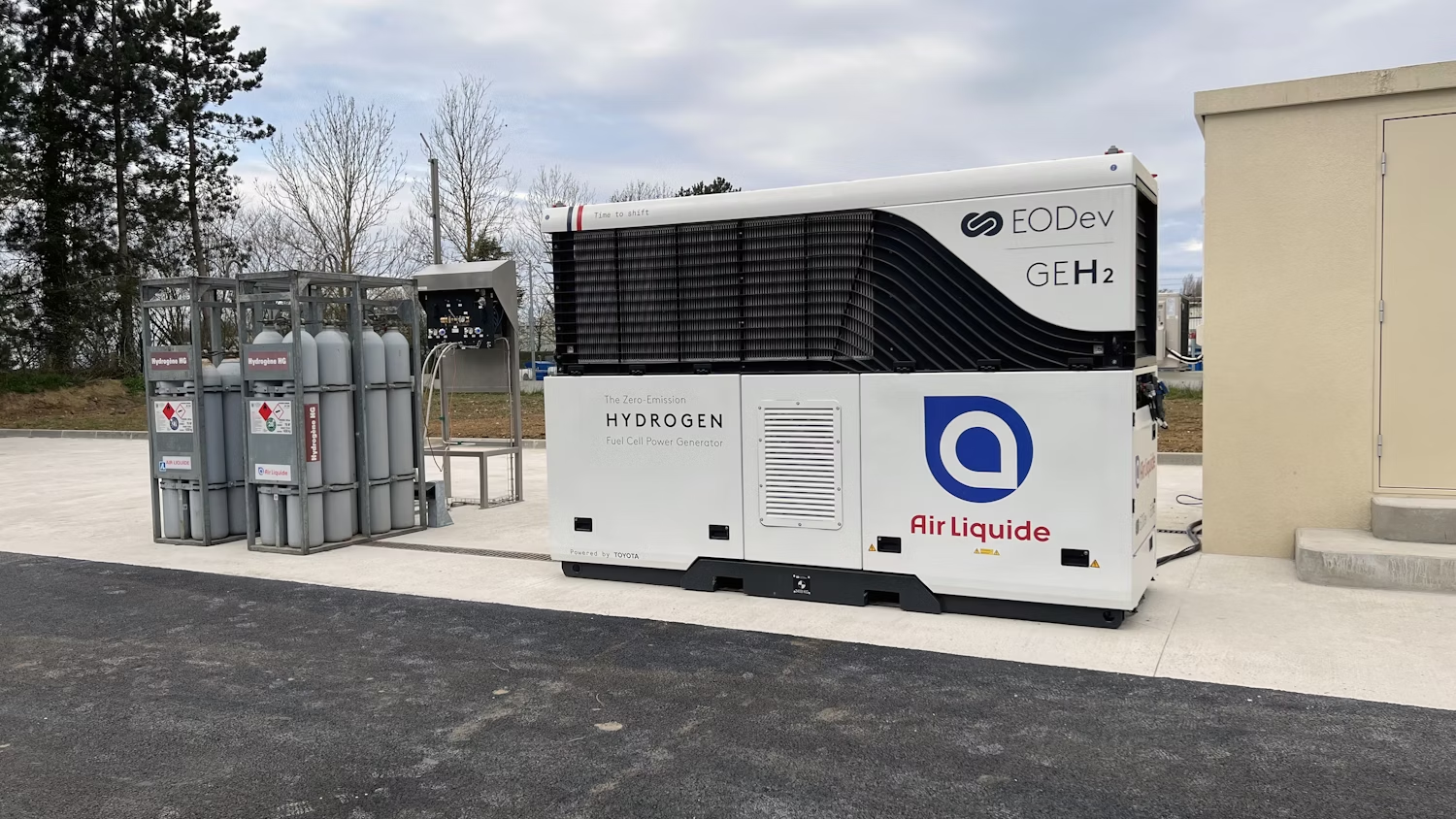
Back-up system for Air Liquide
To ensure uninterrupted operations in the event of a grid failure, a GEH₂ unit has been deployed in backup mode on the company’s historic campus.
Powering a NATO military base
As part of an exercise involving 20 military delegations from around the world, NATO deployed a hydrogen-powered generator for a 10-day full-scale test.


Electric Mobility: the real obstacle isn’t the vehicule bu the energy
The number of electric vehicles is growing rapidly, but the infrastructure needed to power them is struggling to keep up. The bottleneck is shifting from the vehicle to the availability of energy in the right place at the right time:
An infrastructure that is sometimes undersized: Installing a fast-charging station requires a level of power that many locations cannot provide without lengthy and costly connection work.
Temporary needs: New model launches, fleets on the move, events—these are all situations where charging is needed without permanent infrastructure.
Off-grid locations: Some areas lack sufficient—or even any—access to the grid.
Consumption spikes: Simultaneous charging of multiple vehicles creates power demands that strain an already overburdened grid. N deployed a hydrogen-powered generator for a 10-day field test.
EODev solutions for grid support and EV charging
The GEH₂, a 100 kVA electro-hydrogen unit powered by a Toyota fuel cell, powers temporary charging stations, supports the grid during peak demand, and ensures a reliable power supply for critical infrastructure—without local emissions of CO₂, NOx, or fine particulate matter.
BESSTIE 120 is a battery storage system that acts as a buffer: it stores energy and releases it during charging, enabling fast charging even on a weak grid, while smoothing out demand. When paired with the GEH₂®, it forms a complete hybrid architecture.

Electric mobility: energy infrastructure at the core of the transition
Electric mobility is no longer a market of tomorrow. Fleet electrification mandates, corporate net-zero commitments, Low Emission Zones in major European cities, and rapid EV adoption across the US, UK and continental Europe are pushing energy demand faster than public grid infrastructure can follow. For every player in the transport ecosystem — charging point operators, fleet managers, dealership networks, site developers, mission-critical infrastructure owners — the bottleneck is rarely the vehicle or the technology. It is the power available on site.
Grid interconnection or reinforcement typically takes 12 to 36 months in most European and North American markets, and can involve substantial connection fees. Meanwhile electric mobility projects have already been committed to shareholders, boards and the public. On-site zero-emission power generation and storage bridges this gap — enabling deployment now, without waiting for the utility timeline.
How EODev supports electric mobility deployment

Powering EV charging where the grid is insufficient
Corporate campuses, dealership networks, product launches, logistics depots and rental fleet hubs often need to charge dozens of electric vehicles simultaneously — a load few sites can absorb from the existing utility connection alone. The GEH₂® delivers 100 kVA per unit and can be paralleled to reach fleet-scale power, while the BESSTIE® 120 smooths peak demand and enables hybrid configurations that absorb fast-charging spikes without overloading the site.
Backup power for critical mobility infrastructure
Charging stations, transport depots, industrial campuses supporting electric fleets, and any facility whose continuity underpins the mobility ecosystem cannot afford unplanned downtime. The GEH₂® and BESSTIE® 120 provide zero-emission backup power in case of grid failure and act as a bridge during scheduled outages or utility maintenance windows — keeping mobility assets available around the clock.
A field-proven fuel cell platform across critical infrastructure
The Toyota fuel cell inside the GEH₂® is the same platform used in the REXH₂®, our marine hydrogen solution certified by Bureau Veritas (TAC certification) and deployed on professional and competition vessels, including America’s Cup chase boats. This common core delivers the reliability and safety maturity required to support electric mobility infrastructure at scale — from urban charging hubs to remote deployments and industrial backup.

FAQ — Electric mobility and zero-emission energy solutions
How can I deploy EV charging when the local grid cannot handle the load?
A hydrogen generator like the GEH₂® delivers 100 kVA per unit and can be paralleled to match fleet or high-power charging demand. Combined with the BESSTIE® 120 battery storage, it absorbs fast-charging peaks and enables simultaneous charging of multiple vehicles without waiting months or years for grid reinforcement.
Are these solutions compatible with existing EV chargers (AC Level 2, DC fast, CCS, CHAdeMO)?
The GEH₂® provides standard AC power upstream of your existing charging hardware — AC Level 2 wallboxes, DC fast chargers, CCS or CHAdeMO connectors. It integrates transparently with third-party charging equipment, and the BESSTIE® 120 can be added for load management, peak absorption and instantaneous response during high-demand cycles.
How does an EODev solution compare with waiting for grid reinforcement?
Grid interconnection or reinforcement typically takes 12 to 36 months and can involve substantial connection fees. An on-site GEH₂® + BESSTIE® 120 setup can be deployed within weeks, unlocks sites where grid upgrades are not economically viable, and directly supports ESG and net-zero commitments through zero local emissions. On many projects it is deployed as a bridge solution while grid works are underway, then repurposed for backup or other sites once the utility connection is live.
How is hydrogen supplied to a permanent electric mobility site?
Compressed hydrogen is delivered in racks and stored on site, then connected to the GEH₂® according to charging profile and expected consumption. EODev supports the sizing exercise and helps coordinate with regional hydrogen suppliers. The workflow is close to conventional fuel delivery, without ground contamination or local combustion emissions.
How do I integrate an EODev solution into my electric mobility project?
EODev designs and manufactures the GEH₂® and BESSTIE® 120. To assess the right configuration for your project — charging load, autonomy, site constraints, backup requirements — contact our team. We support you in defining your zero-emission electric mobility energy strategy.


