
The construction sector has always been a major energy consumer, but the trend is accelerating with the increasing electrification of worksites and the development of electric site machinery. Faced with growing energy requirements, both for powering infrastructure and recharging equipment, EODev offers a complete range of solutions tailored to these specific needs. Used on their own or in parallel, GEH₂ and BESSTIE will be major allies.
Our solutions in action
Roadworks in the heart of Paris
Vinci construction & Loxam power a zero-emission worksite with a GEH₂ in the heart of a residential area. The electro-hydrogen unit helped to power the living quarters and recharge several electric vehicles on site.


An emission free powered construction site
In the heart of a protected Natura 2000 site, three GEH₂ have been paralleled with a battery system to power a worksite and recharge its equipment continuously for 10 days.
A dredger powered by hydrogen generators
To power a cutter suction dredger in real operating conditions, a floating energy platform built around two hydrogen power generators (GEH2) was deployed. Over two weeks 23MWh of decarbonized energy were produced

How to choose a zero-emission construction site generator
A power generator
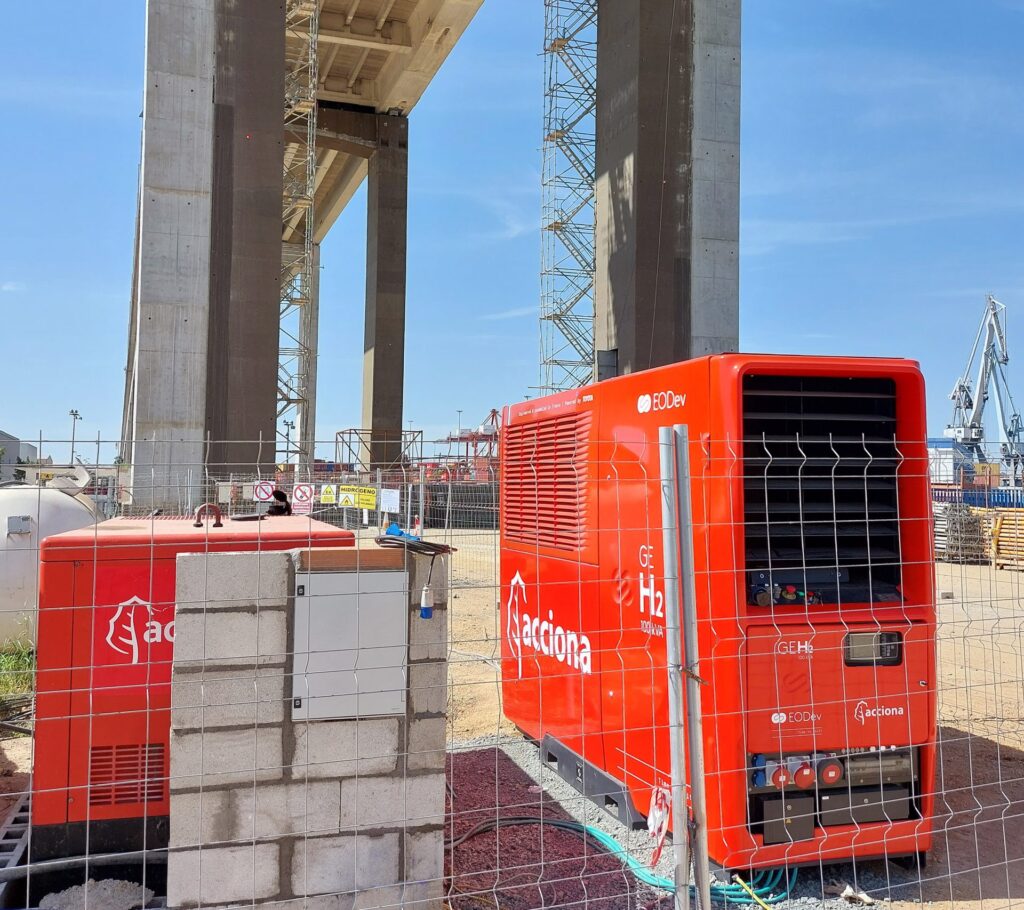
The GEH₂ is a 100 kVA hydrogen-powered generator that can be connected in parallel to meet higher power demands. Equipped with a Toyota fuel cell, it powers a field camp, recharges machinery and electric vehicles, and provides a reliable temporary power supply at approximately 65 dB (the level of a conversation), with connected monitoring of performance and hydrogen levels.

A battery system
BESSTIE 120 is a battery energy storage system (BESS) that manages consumption peaks and smooths out demand. When paired with the GEH₂, it forms a hybrid architecture that optimizes hydrogen consumption and ensures a stable power supply, even during periods of high demand. These two solutions are part of a zero-emission product line that also includes the REXH₂ for maritime applications.
Sizing power for jobsites and mining operations
Site cabins, tower cranes, welding stations, EV charging for electric machinery, dewatering pumps: each load profile requires specific sizing. The GEH₂® delivers 100 kVA per unit and can be paralleled to cover higher loads, while the BESSTIE® 120 smooths peak demand and enables hybrid configurations — reducing hydrogen consumption and improving overall efficiency on long-duration worksites.


Regulatory alignment and business case vs diesel
A zero-emission construction site generator supports compliance with LEZ, CARB Tier 4 Final, EU Stage V and the emerging non-road mobile machinery (NRMM) requirements adopted by major cities. Beyond regulation, the total cost picture includes reduced maintenance (no oil changes on the fuel cell core, unlike diesel engines), noise reduction acceptable in residential and mixed-use urban worksites, and eligibility for green financing schemes and public tender bonuses tied to embodied carbon.
Hydrogen fuel logistics on remote and off-grid sites
For construction and mining sites away from grid infrastructure, fuel logistics is central to the choice. Compressed hydrogen is delivered in racks that can be stored on site and replaced according to consumption, in a workflow comparable to diesel resupply, but without combustion, exhaust, or ground contamination risk. This makes hydrogen a viable option for Natura 2000 areas, protected watersheds, and remote extraction sites where any fuel spill has heavy environmental consequences.

Vous avez une question, nous avons la réponse.
Yes. The GEH₂® provides the AC power required to charge electric excavators, telehandlers, aerial platforms and light electric commercial vehicles used on modern jobsites. Paired with the BESSTIE® 120, it also absorbs the high instantaneous demand of fast-charging cycles, ensuring stable power for the rest of the site.
Compressed hydrogen gas is delivered in racks and stored on site, then connected to the GEH₂® according to expected consumption. Logistics are anticipated at the sizing stage based on required power, load profile and project duration. For long-duration or fully off-grid mining operations, a scheduled resupply is coordinated with regional hydrogen suppliers, in a logic close to conventional diesel delivery — with the benefit of no ground contamination or combustion exhaust.
The GEH₂® emits no local CO₂, NOx or particulate matter at the point of use — only water vapour. It therefore falls outside the scope of engine emissions standards (CARB Tier 4 Final, EU Stage V) which apply to combustion engines, and it complies with the strictest Low Emission Zone frameworks in London, Paris, and other European city centres.
Beyond fuel cost, the comparison factors in reduced maintenance (no engine oil, no combustion wear), suppression of local air and noise pollution — which unlocks urban and residential worksites otherwise closed to diesel — plus eligibility for green public tenders and low-carbon financing schemes. On long-duration or high-visibility projects, these dimensions typically drive the total value of a zero-emission jobsite power strategy.
EODev designs and manufactures the GEH₂® and BESSTIE® 120. To assess the right configuration for your project (power, autonomy, site constraints, machinery mix) and its deployment model, contact our team — we support you in defining your zero-emission jobsite power strategy.


